Gemini_Generated_Image_s63n9ks63n9ks63n_1777249783
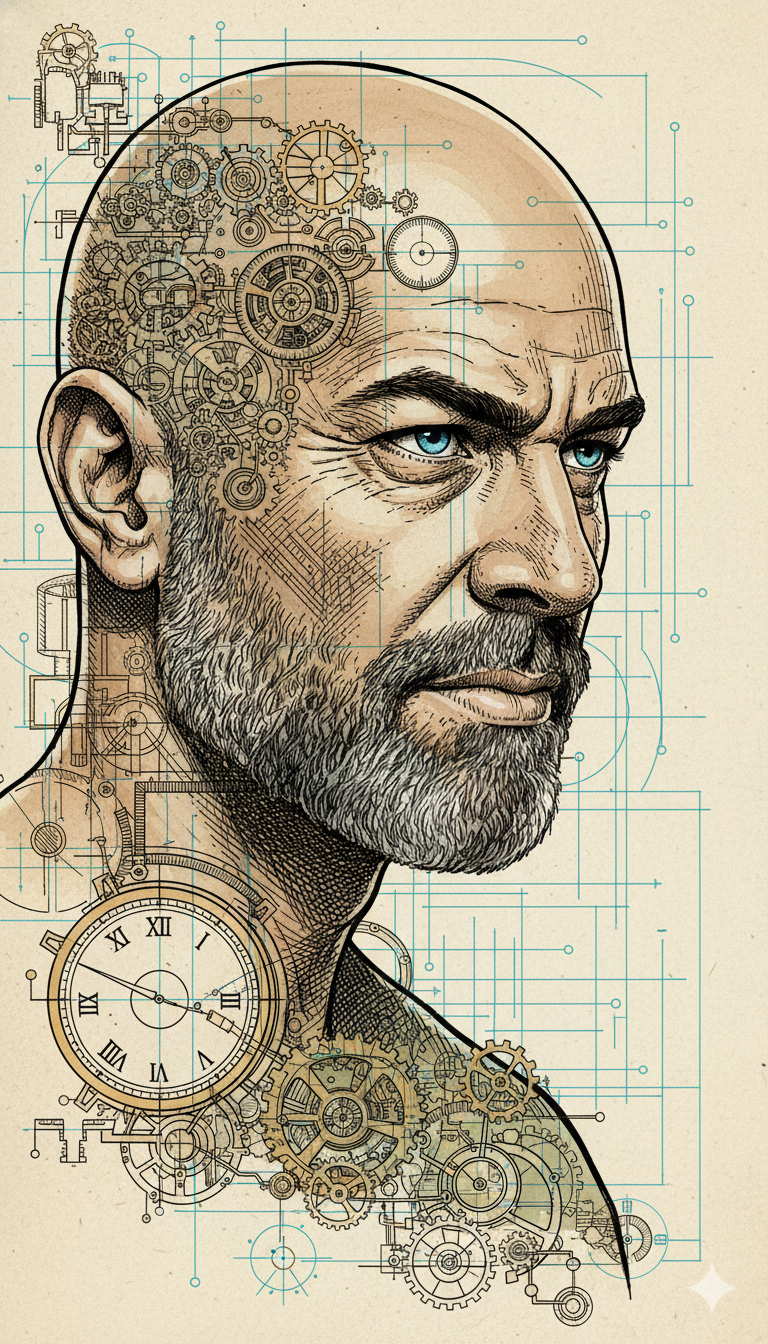
Use the attached photo of the man and create an ultra-detailed vertical portrait illustration. Do not alter the gender presentation or the overall vibe of the person; only the environment, abstraction, and graphic overlays can change, while the character remains instantly and unmistakably recognizable as the same person from the submitted image.
Create an ultra-detailed vertical portrait illustration that combines semi-realistic comic book illustration with schematic tech design art, keeping the character's face and hair exactly the same as in the reference photo. The main subject is a man (from the attached photo) rendered with fine cross-hatching shading, an angry, focused, and dominant facial expression, in the style of traditional hand-inked illustration.
Use a 3/4 profile close-up of the face looking to the right, with the head filling most of the frame in a dense and technically symmetrical composition. The perspective is slightly dramatic to emphasize the facial structure and eyes, but should not distort or alter the original facial identity or hairstyle.
Half of the head and the surrounding background should be combined with complex mechanical and design elements: clockwork mechanisms, gears, cogwheels, dials, Roman numerals, technical lines, architectural diagrams, engineering plans, mechanical symbols, concentric circles, mechanical maps, and high-precision technical grids. All these elements should interconnect with fine, precise technical drawing lines, forming a clean and ultra-ordered schematic network around and partially over the subject, without obscuring or distorting the face.
Visual style: deep black line art with extreme micro-details, clean technical ink, a blend of traditional hand-drawn illustration and futuristic mechanical design. No blurring, no random noise, no pictorial smudges; each line should be sharp, controlled, and legible, as if drawn for the cover of a high-quality technical comic book.
Color palette: dominant beige/cream tracing paper tone, black, gold, brown, with touches of olive green in the skin shadows and touches of bright blue in the eyes. All lines, annotations, numbers, and technical symbols on the page should be rendered in a very light, soft blue ink, like classic cyan markings on cream tracing paper—clearly visible, yet subtle and harmonious. Keep the contrast high, but balanced, using color selectively to highlight the face, eyes, and key mechanical structures, while maintaining an overall aesthetic of technical illustration.
Texture and atmosphere: retro-futuristic and steampunk, with vibes of scientific schematics and mechanical intelligence, giving the feeling of a fusion between classic comic book portrait art and high-precision machine design diagrams. The subject should radiate power and focus, as if their mind were mechanically calculating in real time through the surrounding schematics.
Background: completely filled with technical schematics, geometric symbols, gears, and mechanical diagrams, with no empty negative space. The image should be dense from top to bottom, with consistent and extreme detail and coherent design logic throughout the screen.
Final quality: ultra-sharp focus, 8K resolution appearance, extremely high detail, clean and consistent rendering, no distortion, no extra characters, no meaningless text, no watermark, and no changes to the original face, hairstyle, or gender — only the style, mechanics, design overlay, and light blue annotations are transformed.