Multiplas_camadas
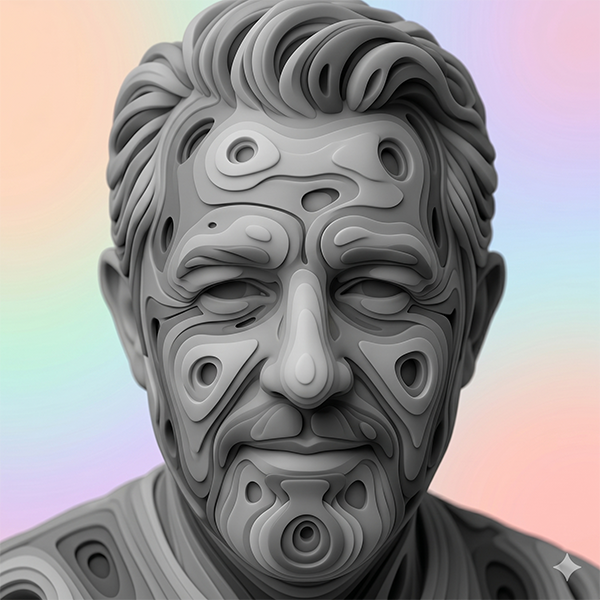
Use the uploaded image as the subject and the only identity reference. Maintain the exact same person from the reference photo with strict IDENTITY LOCK: same facial features, bone structure, skin tone value, gender, perceived age, hairstyle shape, and overall facial proportions. Preserve the exact facial expression, eyes, nose, lips, jawline, and any unique details such as moles, freckles, scars, or skin texture. Do not change the person’s gender, do not make the face younger or older, and do not alter the head or body silhouette. Preserve exact facial structure, proportions, and feature placement, keeping natural expression and full recognizability.
POSE & COMPOSITION — LOCKED: Keep the same head angle, orientation, and framing as in the uploaded image. No rotation, no mirroring, no perspective changes, no cropping that significantly alters composition. Treat this as a pure style transformation of the existing portrait, not a new pose.
STYLE TRANSFORMATION — ORGANIC TOPOGRAPHIC SYSTEM: Transform the entire subject (face, hair, clothing) into a flowing, abstract, layered organic structure. Rebuild all visible surfaces of the person using smooth, liquid-like contour layers that stack and flow over each other. The layers should resemble melted topographic lines or soft carved foam, wrapping around the facial structure and body. Integrate rounded cavities, holes, and porous cutouts throughout the forms, with clean, smooth shapes that contribute to depth and complexity. Maintain a continuous, seamless material flow across face and hair with no break in material type, as if the entire figure is made from the same sculpted substance.
TEXTURE & MATERIAL — CRITICAL: The subject’s overall surface should appear soft, rubbery or foam-like, with a smooth matte finish, not glossy plastic. Use subtle inner beveling and soft depth shading to define each layer, emphasizing thickness and overlap. Cavities and holes must have clean rounded edges and slightly darker inner depth, giving a sense of hollowed-out forms and porous organic structure. There should be no realistic skin or hair texture anywhere on the subject — everything on the person is converted into abstract layered material.
COLOR SYSTEM — GRAYSCALE SUBJECT + PASTEL BACKGROUND: Keep the entire subject (face, hair, clothing, topographic layers and cavities) strictly in grayscale tones only, from soft light gray to deep charcoal. Apply smooth monochrome gradients across the layered forms, following contours and topographic lines, with strong tonal contrast between adjacent layers to clearly separate depth. The background, however, is not grayscale: transform only the background into a soft pastel gradient field, blending gentle colors like pale peach, soft mint, light lavender, baby blue and warm blush. The pastel gradient should be smooth and atmospheric, with no hard shapes, creating a calm, colorful contrast behind the monochrome sculpted figure.
FACE & HAIR TREATMENT — UNIFIED MATERIAL: The face and hair must be fully integrated into the same layered topographic system. No visible hair strands; hair becomes flowing contour masses and layered shapes that follow the original hairstyle volume and direction. Facial features remain accurate and recognizable, but are sculpted from layered forms: nose, lips, eyelids and jawline defined by stacked contours and subtle grayscale shading rather than realistic texture. The identity is clear and locked to the reference, but expressed through abstract sculpted grayscale layers.
DEPTH & LIGHTING: Use soft ambient lighting with gentle, consistent shadows between layers and inside cavities to reinforce depth on the subject. Emphasize depth through stacking, overlap, and cavity shading instead of harsh directional light. The pastel background should remain softly lit, with smooth color transitions and no strong shadows, so the grayscale layered figure stands out in front of a dreamy, gradient color field.
The final image should look like a high-resolution organic topographic sculpture of the original portrait in black, white and gray, standing out against a smooth pastel color gradient background.
Camera, lens and technical look
Preserve the same virtual camera setup as the original photo: same crop, shot scale, and perspective. Simulate a standard portrait lens look (50–85mm full-frame equivalent) with natural perspective and slight depth of field if present in the original. Keep the face and layered subject in sharp focus, with the pastel gradient background softly blurred or perfectly smooth. High-resolution, ultra-clean rendering, with no visible artifacts or pixelation.
Style and detail tags (positive)
identity locked face from uploaded photo, organic topographic portrait, layered foam-like structure, smooth contour layers, melted topographic lines, rounded cavities and porous cutouts, unified grayscale material for face and hair, matte rubbery surface, inner bevel shading, monochrome gray gradients on subject, pastel gradient background, soft peach mint lavender baby blue tones, subject in grayscale, background in soft color, soft ambient lighting, gentle cavity shadows, abstract sculptural look, high resolution, ultra detailed, clean geometry, seamless integration of subject and gradient backdrop.
Negative prompt
No photorealism, no natural skin texture, no visible pores, no realistic hair strands, no individual hairs. No colored layers on the subject (colors must appear only in the background gradient), no rainbow gradient on the person, no saturated or neon tones on the subject. No sharp hard edges that look mechanical or polygonal, no jagged geometry, no broken topology, no geometry breaks. No noise, no grain, no motion blur, no general blur on the subject’s face, no out-of-focus main subject.
No distortion of facial proportions, no change of identity, no altered eyes, nose, mouth or silhouette, no change in gender or age. No added elements that are not part of the layered structure or smooth gradient background (no text, no logos, no extra props). No strong directional harsh lighting, no blown-out highlights, no crushed shadows, no patterned or textured background instead of a smooth pastel gradient.